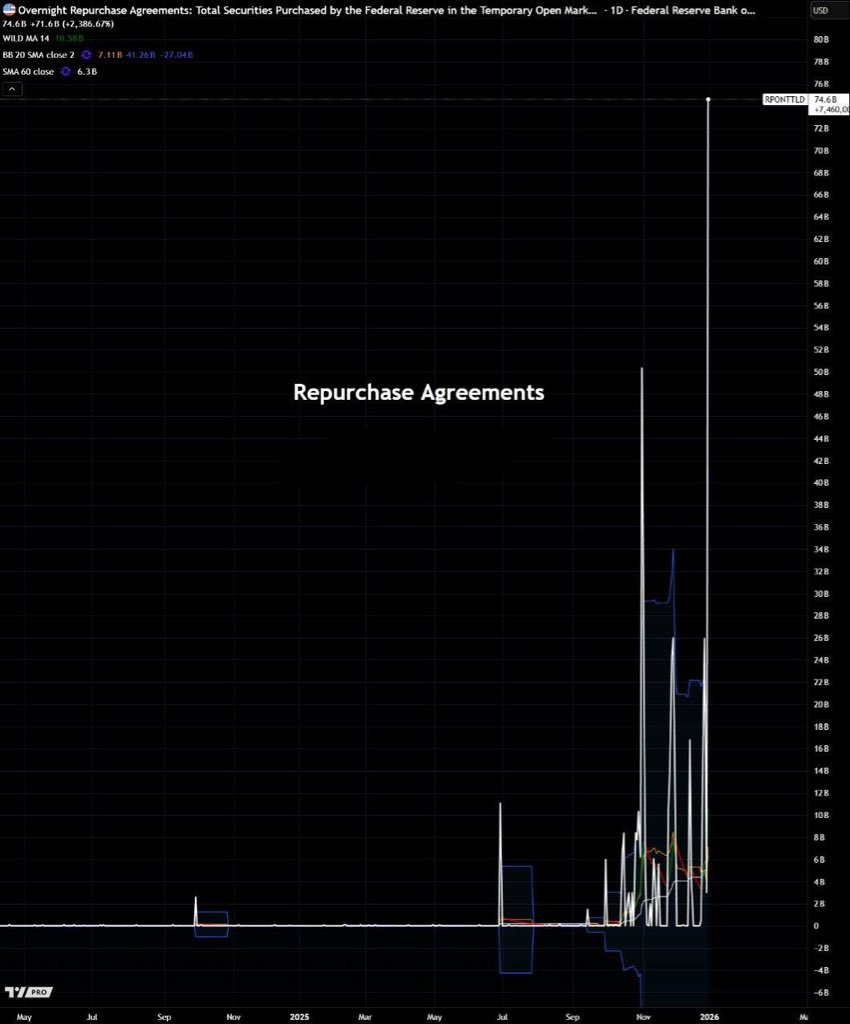
This is a video of Yanis Varoufakis is explaining the content of a meeting of the capitalist world’s “most powerful central bankers”.
It’s as if we can see the train coming, but can’t get off the tracks.

This is a video of Yanis Varoufakis is explaining the content of a meeting of the capitalist world’s “most powerful central bankers”.
It’s as if we can see the train coming, but can’t get off the tracks.
Someone is in the shit. This is more cash than 2008. Rumour control says 9 million ounces of silver are needed to cover today. Silver price is being hammered (with this money?). How long before the west catches up with the Shanghai price (was $10 dollars higher 30/12)?
It’s AI isn’t it Pat? How can we trust it?
BTW Varoufakis has been complaining recently about being AI’d all over the place.
You’re right. One can only make a judgment call, based on consistency of message (does this follow what has been said before), the body movements, and of course ones own confirmation bias. As @LocalYokel has said. Someone is in the shite. And we all know the three major European players (Britain, France and Germany) are financially in desperate states and various stages of decline. So AI presentation or not, I’m inclined to believe that Varoufakis message.
I wish there were a more black and white answer to your question.
What do you trust nowadays? I’ve seen the comments about the links I use, eg Slaynews. Not fond of it, but we’re well past the time that the Guardian or Times was trustworthy, aren’t we?
Reality is that you cannot trust anyone, all you can do is try to fish out the nuggets of truth. Kallas spoke about how they can’t beat China if they can’t beat Russia. The woman is absolutely untrustworthy and uneducated too, but I believe the above is truth.
At the end of it all, we’re at that quote about studying currentl reality whilst they create new ones
Last time we watched a Varoufakis presentation he was explaining that banking between countries isn’t like personal banking where the banks lend out depositors’ money. WTF.
Can’t trust even him again . . .
Making a “deposit” is giving the bank your money. Legally it’s no longer your money. Bank is free to do what they like with it.
Hi @Rich . One item I forgot to add to my answer above is look at the Youtube channel that the video is coming from. The one I posted above is from the “Yanis Varoufakis live” channel. Anything with a spurious channel name should be immediately suspect.
Cheers
Blimey LY, are you trying to live up to your moniker? 
Banks ‘create’ money out of thin air. The easiest example of this is the mortgage business. (Is this not common knowledge??)
In other words, banks invent ‘their’ deposits: the ‘deposits’ of which you write, money ‘saved’ by people in bank accounts, constitute a small fraction of what the banks lend out. Varoufakis was either oversimplifying to the point of error or deliberately obfuscating.
Me no like.
( I have ignored interest in the following)
If Bank A lends £1,000 to mr x they transfer £1000 electronically to mr x’s current account with Bank A and register a new asset in their assets register - mr x’s debt he owes to Bank A.
At this point Bank A has created 2 new obligations - a debt in favour of mr x for £1,000 ( the increase in his current account) and a debt owed by mr x for £1,000 in favour of Bank A. Bank A has not increased or reduced its net assets and Mr x has not increased or reduced his net assets - no money has been created.
Mr x has a choice to make:
Results of each choice are :
The 2 obligations are cancelled and no money has been created or lost at any stage.
i) Assuming Bank A has sufficient cash assets it will reduce those by £1,000, transfer £1,000 in cash to mr x and reduce its debt (mr x’s current account) to mr x by £1,000. Bank A has thereby exchanged its most liquid asset - cash - for a less liquid asset - mr X’s obligation to repay £1,000. No money has been created. Mr x has exchanged £1,000 from his current account asset with cash and continues to owe Bank A £1,000 under his original loan obligation. No money is created, mr X’s net assets remain the same.
If Bank A has insufficient cash reserves it will borrow cash to meet the shortfall. Again no money is created as the bank’s net assets do not change in amount only in liquidity.
ii) electronic transfers between accounts within the same sole Bank do not change the Bank’s net asset position and hence do not create new money. For capital requirement purposes each Central Bank defines where capital is considered to reside, so that the capital of a subsidiary company can be included within the solus capital of the parent, hence transfers to or from such companies can be treated as if they were transfers within the same company.
( I believe this factor makes Richard Werner’s work not proven)
iii) transfers to a different Bank -Bank B- from mr X’s current account can only be done within a system that facilitates the transfer of funds from Bank A to Bank B to fully compensate Bank B for taking over Bank A’s obligation re mr X’s £1,000 current account. This is achieved by adjustments in Central bank reserve accounts held for all banks to satisfy total transfers between all banks each day. Where banks have a shortfall the central bank will step in and lend the funds needed. It is at this point that money is created from thin air by the central bank, but never by commercial banks.
I realise that this conflicts with MMT but I know as a fact that commercial banks have always claimed losses on bad debts for tax purposes and if no losses could be incurred because banks created money from thin air then the banking industry would owe trillions to HMRC!
Cheers
Always. It’s not just a clever name😁
Thanks for your painstaking explanation CJ. I have to admit I didn’t get where I am today without understanding only just enough ‘economics’ to scrape a pass at A-level - which is my way of saying it appears to this simple soul as basically all smoke & mirrors.
So, I can’t begin to challenge your exegesis (wouldn’t want to!) but, at the risk of being a bore, I would like to know what part is played in this scenario by ‘the depositor’, and how it is that no ‘money’ has been ‘created’ but Mr.x now has £1000 at his disposal that he didn’t have before.
A new version of immaculate conception?
Happy new year by the way.
This is also a reply to @CJ1
Good explanation @CJ1 . However, you didn’t explain how the fiat money appears. It’s like this.
In your example. bank A must have £1,000 to lend to Mr X. However, if they have £1,000 of assets, the bank can lend typically £9,000 under the practice of “fractional reserve” lending. The first £1,000 they lend will be the banks own money. The next £8,000 is garnered from the ether! The bank does not have that money or assets. It just appeared, as if by magic or more accurately, by Rothchild banking rules. That’s how fiat money is created.
The interesting thing about this style of banking (making money grow on trees for the merchant bankers (lucky I didn’t use predictive text for that last word), is that of “seven countries the US planned to take out in five years”, Libya and Syria were the last remaining of three. Iran is now the last of Islamic interest free banking countries! Now isn’t that a coincidence?
I have not tried to analyse all of a commercial bank’s balance sheet - depositors are similar to any other lender except in terms of bankruptcy and statutory guarantees for certain amounts. Terms of deposits can be at immediate call of the depositor or limited by time and penalties. As far as all banks are concerned deposits are part of their reserves which can be invested in anyway the bank is permitted to operate including personal loans to customers. But deposits are not part of the myth of money creation since, like all loans to banks, they do not create additional money but exchange immediate liquid funds for a less liquid bank obligation to repay those funds. Neither party to a deposit increases or reduces their net assets, so no money is created.
As far as mr X’s bank loan is concerned if he takes it out of the bank in cash he has entered into a loan agreement which creates an equal and opposite obligation to the cash and so his net assets are the same before and after this arrangement. No money is created free of any additional and equal obligation.
I also took A level economics in 1966 - I was lucky it eased my way onto a law degree course.
Happy New Year
Cheers
Hi @PatB, the internet is telling me that the UK dropped fractional reserve banking regs in 2006 but even when we had them the rules just limited the ability to lend above a ceiling these rules did not change the mechanics of lending. The mechanics are as I described above, it is only the Central Bank that creates money from thin air usually through loans to central reserve accounts where liquidity is a problem. QE is of course the other well known method of creating money.
Cheers
Thanks for elucidating this @CJ1 - and the questioners!
Good to see exactly when the magic occurs, and which one is the magician 
Hi @CJ1 . Thanks for educating me on the dropping of the fractional reserve rules. I wasn’t aware they had gone. I’m now trying to understand the new rules. But …
… I do not believe that the new rules stop banks from creating money from thin air. It seems to me that it is just a bit more obscure so us hoi poloi don’t know that it’s fiat currency.
For further thoughts, highly random, here’s my first reply to a post on this site:
I also copied a link to Mike King’s 2015 32 page pdf called “why positive money is wrong: an obligations analysis of broad money growth- which appears to have gone from the net but is reviewed here :
Cheers
Very interesting to read through this thread and to reflect on the position of one of those too big to fail AI behemoths.
nVidia to be specific. They create shell companies, sell masses of GPUs to them, this manifests as impressive sales growth, cheers up the investors, and inflated the capital side of the balance sheet (by virtue of share capital price rises).
Repeat until someone queries how come the same GPUs seem to be being trucked from shell A to shell B then shell C, or the share price tanks.
Delphically, Kieron
There also seems to be a link between AI use of GPUs and the expansion of AI image recognition activity - and of course such technology needs power which requires resources to be prioritised for AIs over people! AIs will ultimately fulfill the eugenics’ purpose of a world firstly without free people and then without people - opposition to AIs is not a luddite ideology it is humanity’s survival, imo.
If people have the freedom and knowledge to decide whether to support or oppose AI then the elites have understood it is time to prevent those people from exercising freedom by controlling both movement and spending through facial recognition zoning and Central Bank Digital currency programming.
There is a clear link between the Positive Money ideology of blaming all our economic problems on the power of commercial banks to create money (which PM believes can and should be solved by centralising lending decisions in an “independent” regulatory authority) and Central Bank Digital programmable currencies.
PM should be careful what it wishes for…imo.
Propaganda and public ignorance has created industries like virology and CO2 climate change fanaticism as well as genocide, moving trillions of taxpayers’ money away from social care into social control and destruction - we are running out of time!
cheers