5 Filters

NY Times features Israeli settler terrorism in deep article

(Meryl Nass substack post)

It seems even the Times realizes this will lead to the end of Israel and is finally being honest about it. I left out the photos because they are copyrighted

https://www.nytimes.com/2026/08/31/world/middleeast/west-bank-israel.html

[

A growing number of former Israeli generals, intelligence officials and prime ministers are accusing settlers in the West Bank of committing ethnic cleansing with government support. “Once a society behaves this way,” one said, “that society is doomed.”

By Azam Ahmed, Natan Odenheimer and Ronen Bergman

Photographs by Ivor Prickett

Aug. 31, 2026

Maj. Gen. Eyal Ben-Reuven spent his life fighting for Israel. He survived the Arab-Israeli war of 1973, when his platoon was nearly wiped out, then went on to command a division in the West Bank and lead Israel’s ground forces in the 2006 war against Hezbollah.

But in recent months, he has returned to the Israeli-occupied West Bank, touring the territory with retired generals and former Israeli officials like himself. He has walked through the remains of a Palestinian school looted by Israeli settlers, and listened to Palestinian shepherds and farmers describe being tortured by settlers who seize their livestock and land.

Now, General Ben-Reuven says he has an entirely different understanding of the risks facing Israel today.

“This, what the settlers are doing here, is the real threat to Israel,” he said, his eyes welling with emotion. “This is more concerning to me than Iran, Gaza or Lebanon.”

Other former high-ranking Israeli officials touring the West Bank with him shared the same indignation.

“This is ethnic cleansing, to put it simply,” Ephraim Sneh, a retired brigadier general and former minister of health, said of Israeli settlers’ attacks on Palestinians in the West Bank.

Asaf Agmon, a retired Air Force general, went even further, comparing it to what some Israelis’ forebears endured in the Holocaust — not in the scale of the violence, he explained, but in the effort to erase the Palestinian presence from much of the West Bank.

“Once a society behaves this way,” he said, “that society is doomed.”

Since the Hamas-led terrorist attacks of Oct. 7, 2023, when as many as 1,200 Israelis were killed, war has consumed Israel: first with Hamas, leaving Gaza in ruins and tens of thousands dead. Two rounds of fighting with Hezbollah in Lebanon. Two campaigns against Iran.

But in the shadows of those conflicts, a quieter front has emerged in the West Bank. Armed Israeli settlers, emboldened by the most right-wing government in the nation’s history, raid and torch Palestinian homes, mosques and villages with seeming impunity, openly trying to drive them out of the territory.

Israel’s top military commander in the West Bank has warned that the violence risked setting the territory ablaze. Settlers have waged thousands of attacks in the West Bank since Oct. 7, 2023, injuring thousands of Palestinians, according to the United Nations. More than 3,200 Palestinians have been displaced by settler attacks this year alone — double the rate of last year.

As the pace of violence climbs, the U.N. says, the number of Palestinians injured in settler attacks has risen from an average of one every three days in 2020 to more than three per day in 2026.

The retired generals condemning this violence are part of a small but rapidly expanding array of influential Israelis, including many from the upper echelons of the military and intelligence apparatus, who are publicly declaring the lawlessness in the West Bank a threat to Israel’s existence as a democracy.

More than 200 prominent Israelis signed a letter in June demanding that the government stop the attacks against Palestinian civilians in the West Bank. The signatories included two former prime ministers, more than three dozen retired Army and Air Force generals, the former heads of the nation’s foreign and domestic intelligence services, as well as rabbis, a Nobel laureate and one of Israel’s most revered novelists.

The retired officials come from across the political landscape, including from Prime Minister Benjamin Netanyahu’s own party, and many were considered security hawks.

In their letter, they called for an end to “Jewish terrorism” and the “ethnic cleansing” underway in the West Bank. And they accused Mr. Netanyahu’s government not just of being negligent in failing to stop it, but of pursuing “a deliberate government policy in which the entire security establishment — including the military, Shin Bet and the police — is knowingly complicit.”

The signatories cited tens of millions of dollars in government spending on illegal Israeli outposts and farms, and demanded a full accounting of all public money spent on roads, water, electricity, vehicles and weapons to support them.

They also accused the military of being complicit in the violence, saying soldiers stand by and watch as Palestinians are attacked, or sometimes even join settlers to assault Palestinian villages together.

The public denunciation, given whom it is coming from, is staggering. Activists have often asserted that Israel commits atrocities in the West Bank. But accusations of ethnic cleansing from such a large group of former prime ministers, generals and other top Israeli officials — the same people who once led their nation’s security forces — are virtually unheard of.

Many of the Israeli critics took part in extreme violence during their own military careers, ordering targeted killings, deadly airstrikes, raids and other attacks on Palestinians, including in the West Bank. But they say they were acting in the interest of Israeli security, under a chain of command and legal oversight.

The difference now, they say, is that the violence is unchecked, indiscriminate and targets innocent civilians, with the intent of clearing large stretches of the West Bank so that Israelis can take it for themselves and stamp out any prospect of a Palestinian state.

The injustice today, they contend, has crossed a moral red line in which the state is allowing, and sometimes helping, Israeli civilians beat, stab and shoot others with almost no consequences.

the alarm.

“If I had to, I could make a legal defense of what the Israel Defense Forces have done in Gaza,” said Gal Levertov, the former head of the international division at the Ministry of Justice, who represented Israel before the International Criminal Court in The Hague.

“But what is happening today in the West Bank?” he added. “It’s indefensible.”

The Tour

The retired Israeli generals came to the West Bank on a trip organized by Yaakov Or, himself a retired general who spent much of his career in the West Bank.

Outraged by the escalating settler violence and what he views as the state’s involvement in it, Mr. Or has made it his mission to bring as many Israeli notables as he can to the West Bank to see for themselves.

He often begins with a warning.

“When I take you to see what is happening in the West Bank, you will have two choices,” he said to a group in June. “You can stay silent, and be complicit,” he told them, “or you can speak out, and tell everyone you know about what is happening.”

He then invited anyone who preferred not to be put in that position to leave.

Mr. Or, 79, began his military career fighting for Israel in the Arab-Israeli war of 1967, which ended with the Israeli occupation of the West Bank. He went on to oversee civilian and security affairs in the territory, before retiring from the state comptroller’s office, where he was responsible for investigating the Israeli defense establishment.

Since he began organizing the tours a little over a year ago, more than 250 participants — former military brass, high-ranking intelligence officials, prominent lawyers, economists and diplomats — have joined.

The New York Times accompanied him in June as he led several former officials including generals, a cabinet minister, a military aide to four prime ministers, an intelligence official, a state prosecutor and an ambassador on an arc through multiple villages in the middle of the West Bank. Along the way, highways were lined with Israeli flags, equally spaced, kilometer after kilometer.

Mr. Or asked the visitors to note the miles of new fences erected by settlers to hem in Palestinian villagers and keep them from accessing their own land.

And he urged participants to look for the prevalence of settler outposts, the makeshift frontier encampments placed on hilltops throughout the territory.

“It is showing us the overall concept — how to widen areas of control and narrow the places where Palestinian communities can live,” he told them.

‘They Want to Take My House’

In the village of Burin, Bashar Eid, a Palestinian farmer, took the visitors to his roof, limping behind them with a cane, the result of a settler attack that left him permanently impaired, he said.

He told them about the constant attacks from settler outposts, which were visible from the roof, positioned along the hillsides surrounding him. The settlers enter the village every day, he said, even during the Sabbath.

One recent morning, he said, he spotted a young settler boy walking on his land. When he asked him what he was doing, the boy told him to shut up or they would break his other leg.

“A kid told me that,” he said, shaking his head.

He could no longer farm his land, he said, because settlers attack him when he tries. His days have been reduced to sitting on his roof, watching for settler incursions.

“I don’t know what to do,” he said. “They want to take my house.”

The participants took notes as the heat bore down from above. The scent of sunscreen filled the air.

A former chief state attorney raised his hand. “It is absurd that Israeli forces are not doing their duty to protect them — it is embarrassing to even ask, but why don’t the Palestinians defend themselves?” he asked.

“I’m afraid if I defend myself, it will be even worse for us,” Mr. Eid said.

Mr. Or agreed: Any violent response from the Palestinians would invite retribution, which would be much more severe and likely include the Israeli military, he said. Retaliation against the settlers would be deemed terrorism, prompting more crackdowns, he said.

Raphael Schutz, a former Israeli ambassador to Spain, Norway and the Holy See, mopped sweat from his brow as he processed what he had heard.

He thought of his mother, who had fled Nazi Germany as a 9-year-old with her parents and siblings, he said.

Today, he said, when she watches videos of settlers setting cars ablaze and shooting innocent farmers, she feels shame.

“To her,” said Mr. Schutz, 68, “it is inconceivable that Jews can behave this way.”

“I’m glad I left the foreign service,” he added. “It would be impossible for me to explain this.”

A Community Erased

The Jordan Valley runs north to south along the banks of the Jordan River, a fertile plain that marks the eastern border of the occupied West Bank.

In the last few years, settler violence has displaced several Palestinian communities from the area, largely Bedouin encampments like Hamamat al-Maleh.

Just a few months ago, during a separate visit to the community by The Times, a few families were still holding on. Violent incursions in the middle of the night had already forced most to flee. But when we visited in February, we came across a couple of Palestinian families holed up in a stone edifice from Ottoman times, clustered together on mattresses on the bare floor.

“We don’t even sleep an hour,” said Mohammad Khalil, 37, who was born in the community, as his father had been. “If they come and you’re asleep, you won’t survive it.”

At the time, a school constructed with donor funds sat empty. The last of the students had fled a few days earlier. By March, after a series of settler raids, thefts and attacks, Mr. Khalil and the other holdouts gave up and left, too.

Not long after, residents and activists said, settlers came with a bulldozer and leveled the school. Settlers shared a video of themselves celebrating Passover amid the ruins.

By the time the retired Israeli generals and other dignitaries arrived in late June, the Palestinian residents were long gone. Mr. Or wanted to show them what an erased community looked like.

The group walked past the broken school structure, where loose strands of rebar poked through the rubble like unkempt hair. A roll of artificial grass lay in dirty folds. A broken concrete wall betrayed traces of a destroyed mural.

Within the old Ottoman structure, an office was upended. Desks in disarray, a door torn from its hinges lying on the floor.

Elie Avidor, an activist who helps organize Israeli volunteers to protect Palestinians from settler attacks, said he was in the village not long after the school was destroyed and took video, which he later shared, of settler women and children looting notebooks and markers from the office.

Left behind were piles of academic detritus, smashed cabinets, shards of glass and scattered papers.

“When you are burning books, when you are destroying knowledge and attacking children, you’re like the Germans,” said Nehemia Dagan, 86, a retired Air Force general who helped build Israel’s helicopter capabilities and also served as the chief education officer of the Israel military.

“We have lost ourselves, and we have lost this fight,” he said, shaking with rage.

“We must separate,” he added, referring to the two-state solution, which would establish an independent Palestinian state alongside Israel. “Not for their sake, but for our own.”

‘It’s Like a Jail’

On the last stop, in a barren valley in the northern Jordan Valley, a young Palestinian farmer stood before the ranks of Israeli visitors and pointed.

Behind him, a settler outpost had been scraped into the side of a hill, the Israeli flag flying over it. In front of him, a few hundred feet away, stood a long line of Israeli flags, planted one after the next, as if lining a parade route.

Nearby, settlers had erected a fence, turning his farm into something of a holding pen.

“Six months ago, this was our land,” he said. “Now, it’s like a jail.”

As recently as January, life in his village had been relatively normal, he said. They farmed, grazed their sheep, and came and went as they pleased.

That ended abruptly with the arrival of the first settlers, who stationed themselves on the hillside, he said. Now, the farmer and his family could no longer use his farmland or harvest his crops.

He was forbidden from accessing it, he told the assembled visitors, and every time he tried, settlers called the police. He had already been arrested four times, he said, though he was always released.

But whenever he called the police to report harassment, or vandalism of his water tanks, “they never answer,” he said. The Israeli national police said they “investigate every complaint or incident involving suspected criminal activity, impartially.”

The Palestinian farmer said he decided to sell his sheep, rather than lose them to settlers or starvation because he could no longer go out and graze them.

“They should see this reality, and not accept it,” the farmer said, referring to the Israeli generals.

Many of the men assembled had played their own roles in violence against Palestinians — authorizing killings and striking locations, knowing that children might die in some cases — because they believed it helped ensure Israel’s security.

But the settler attacks in the West Bank were not making Israel safer, several of the retired generals said. Instead, the violence and intimidation were having the opposite effect, they argued.

“When you ruin the image of Israel, the diplomatic value of Israel and the core values that hold the military together, you achieve nothing,” said Mr. Agmon, the retired Air Force general.

“I’ve earned the right to speak,” added Mr. Agmon, 78, whose grandson, an Israeli soldier, was killed in Lebanon last year. “My family and I paid the highest price for this country.”

“I am ashamed of what our people are doing here,” he said.

Azam Ahmed is international investigative correspondent for The Times. He has reported on Wall Street scandals, the War in Afghanistan and violence and corruption in Mexico, Central America and the Caribbean.

Natan Odenheimer is a Times reporter in Jerusalem, covering Israeli and Palestinian affairs.

Ronen Bergman is a staff writer for The New York Times Magazine, based in Tel Aviv.

Ivor Prickett is a photographer based in Istanbul. He covered the rise and fall of ISIS in Iraq and Syria while on assignment for The Times. More recently he has been working on stories related to the war in Ukraine.

See more on: The Israel-Hamas War, Benjamin Netanyah
https://merylnass.substack.com/p/ny-times-features-israeli-settle r

1 Like

Ta for this E, and here’s some more commentary on Israel’s terrorism. Hope you’ll see it as useful and not contrary!

“The injustice today, they contend, has crossed a moral red line in which the state is allowing, and sometimes helping, Israeli civilians beat, stab and shoot others with almost no consequences.” [my emph.]

This is effing incredible. And, btw, love the 'almost’.

Just a thought, has the NYT enlightened us as to the lovely generals’ take on Gaza, ‘eyes welling with emotion’? Or is that all over now, move along, look at what those awful settlers are doing on the West Bank. OMG they might even bring Israel into disrepute!

Over a dozen or so years ago we attended a meeting of the then ‘Christian Socialists’ group in Shrewsbury on the subject of Israel/Palestine addressed by Alun Michael MP. The little weasel insisted that it was that right-wing Netanyahu that was the problem, Israel just needed a change of leader and all would be well. The preservation of Israel was of course his, and the current mainstream’s, priority, as ever.

Anyway, well done NYT. (sarcasm alert)

2 Likes

Yep I guess it’s the old bad cop, even worse cop routine

In my humble opinion, there are all sorts of people crawling out of the woodwork, trying to cover their rear ends. Miliband is an especially egregious example of this. He made a statement recently that he was horrified listening to UK doctors that had been in Gaza. FFS which rock have you, and those Israeli generals being living under the past 70 years?

1 Like

I know I should have read the article, but I’m just so sick of all the constant apologists, “define genocide”, or “do you condemn Hamas”, or “… the most moral army”, or “the only democracy in the Middle East”, or, I could go on but I won’t.

My view is that karma is coming and Mondoweisss, Miliband, and so many others are hoping to either ameliorate the tsunami of karma, or when it comes, say they were on the right side of history.

me too.

Minibrain focussed on:

  1. anti-semitism ( most Israelis are descendants of East Europian Ashkenazi jews who don’t have a semite bone in their bodies unlike most Palestinians!) through a series of examples which no court has ajudicated rather they were mainstream media stamped as such.

  2. a second “Israeli victimhood” - October 7th - where he rehashed all the Israeli propaganda that has been totally debunked by many sources including some in Israel where it was shown there were no burned or intentionally murdered babies on that day ( one was killed accidentally when shot through a closed door inside a house - no one found who fired the shot as far as I recall. Nor were there any reports of rapes of Israelis by Palestinians.
    Minibrain failed to point out the recent reports from Israeli press that Netanyahoo was warned by the UAE of the intended break out by the Palestinian concentration camp refugees - which makes Oct 7 a LIHOP exercise.
    Finally Minibrain conveniently ignored the hundreds of Israelis killed on Oct 7 and later by the IDF under their Hannibal directive!

  3. Of course no mention of the UK’s complicity in genocide. He accepted that 20,000 palestinian kids had been killed deliberately or recklessly by the IDF and although the International Criminal Tribunal for the former Yugoslavia found that the deaths of a couple of thousand of islamic men in Yugoslavia in the 90’s amounted to genocide Minibrain could not possibly say that the mass killings in Gaza amounted to genocide! So if you can’t call it genocide then no-one can accuse the UK of complicity in genocide QED!

No mention of the UK Jerusalem consulate being closed by ISrael! ( maybe this happened after his speech?)

I thought he was a fool as the Energy secretary - now as Foreign Secretary he’s just as stupid.

cheers

1 Like

Thanks CJ. I hope Minibrain is not copyrighted as I inted to use it all the time now. :sweat_smile:

1 Like

High folks - just read this from Jonathan Cook:

I thinks he’s ticked all the right boxes.

"
Jonathan Cook

Jonathan Cook

Britain’s settlement trade ban is cosmetic. For it to work, it must sanction Israel

The UK may end up assisting Tel Aviv by reinforcing a preposterous distinction between ‘illegal’ Jewish settlements and a supposedly ‘law-abiding’ Israel

Jonathan Cook

Sep 11, 2026


[First published by Middle East Eye ]

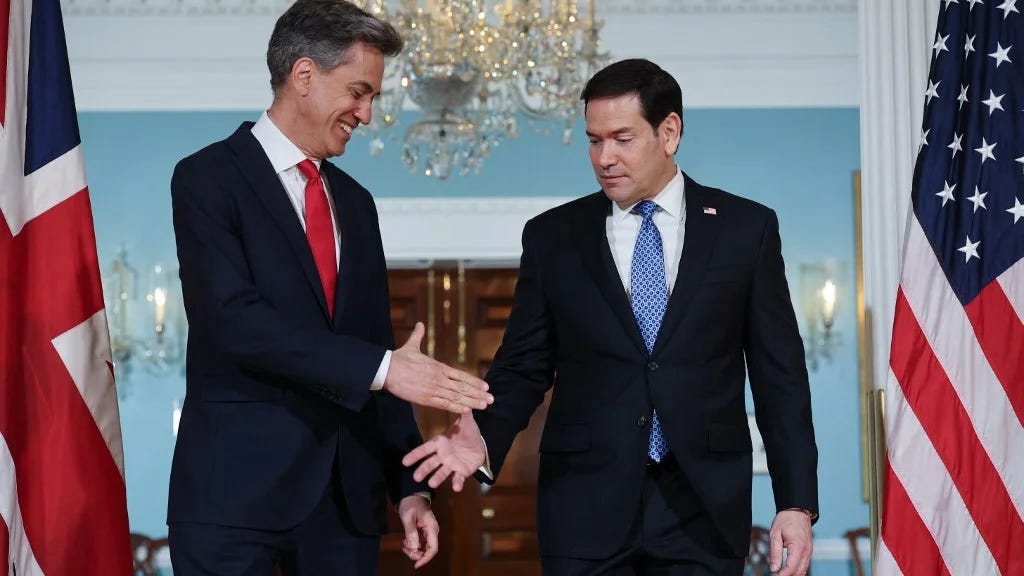
Ed Miliband, Britain’s foreign secretary, this week announced plans for a ban on trade and services with Israel’s illegal Jewish settlements, in a move the government has hyped as a “comprehensive reset” of relations with Israel.

The UK was joined by 11 other western states unveiling or proposing similar sanctions: Canada, Denmark, Finland, France, Iceland, Ireland, Norway, Poland, Portugal, Spain and Sweden.

They presumably hope it will look like they are amassing strength through numbers, upping the pressure on Israel to end the occupation and clear the way for Palestinian statehood.

More realistically, each is hoping it will prove harder for the Trump administration and Israel to single them out as a target in the inevitable backlash against these all-too-modest measures. In quick retaliation, Israel took the unprecedented step of shuttering the British consulate in East Jerusalem – that is, in territory it occupies in violation of international law.

But the idea that these sanctions will amount to a “reset” for UK-Israeli relations looks more like wishful thinking. Shortly before Miliband’s announcement, Bloomberg reported that British diplomats had been privately reassuring Washington that the trade ban on settlements was “largely symbolic”.

According to Alex Wickham, the news agency’s UK political editor, the government’s measures would “have no material impact on the UK’s wider relationship with Israel on trade or security”.

The UK’s trade with Israel’s Jewish settlements is a tiny fraction of its £6 billion ($8bn) overall trade with Israel. And after two decades of largely ineffectual “threats” from Europe to start labelling settlement goods, Israel long ago devised ways to conceal the provenance of such trade. It simply relabels items from the settlements as “made in Israel”.

This is why the Foreign Office has long argued a ban on trade with settlements would be impossible to implement. The “material impact”, as British diplomats are reportedly telling Washington, will be virtually non-existent.

Dishonest reasoning

Similarly, British Prime Minister Andy Burnham’s officials have been downplaying the significance to Labour MPs.

The night before Miliband’s speech, Newsnight reported that backbenchers had been told the government would carefully avoid any echo of the longstanding Palestinian demand for boycott, divestment and sanctions (BDS) against both Israel and the settlements.

A decade ago, Burnham described the BDS movement – backed by leading members of Palestinian civil society – as “spiteful”. During his speech, Miliband similarly went out of his way to emphasise his “wholehearted” opposition to BDS.

But there is something fundamentally, and transparently, dishonest about this approach.

The British public is being told that the UK needs to take “decisive action” in the form of sanctions against West Bank settlements, while Israel itself is to be left untouched. And the government justifies its half-hearted measures on the grounds that the settlements are the chief threat to a two-state solution.

But neither argument makes the slightest sense.

Of particular concern to the British government is a recent decision by Israel to advance a large settlement project called E1, on Palestinian land close to Jerusalem. It is seen as the final nail in the coffin for Palestinian statehood.

The truth, however, is that Israel has been expanding its illegal West Bank settlements for decades, using armed militias to drive Palestinians off their land. This is nothing new.

If the UK were really serious about punishing Israel for its lawbreaking, it would have “reset” relations over the even graver matter of Israel levelling Gaza and slaughtering and maiming tens of thousands of children over the past three years.

It is quite preposterous for Burnham’s government to engage in public handwringing over the damage being done to the chances of a two-state solution by Israel building 1,200 homes in the heart of a future Palestinian state. Britain, after all, has just spent three years helping Israel erase half of that potential state – the half comprising Gaza.

Israel’s wholesale destruction of the tiny enclave ought to be front and centre of any justification for a change of policy, were Burnham really intending to punish Israel and end British complicity. Instead, Israel’s genocide has been shunted into the background, while the spotlight is turned on longstanding settler violence.

This isn’t “decisive action”. This is more smoke and mirrors.

No ‘law-abiding’ Israel

More worrying still, the UK may actually assist Israel by reinforcing a laughable distinction between “illegal” settlements, on the one hand, and a supposedly “law-biding” Israel, on the other.

The effect will be to suggest, quite falsely, that the settlements are somehow discrete from Israel itself. But it is Israel establishing the settlements on stolen Palestinian land. It is Israel servicing them with infrastructure, from roads and electricity to schools and public transport.

It is Israel encouraging Jews to move into the illegal settlements through housing and other subsidies. It is Israel sending soldiers to protect the settlements and crush any opposition from Palestinians.

And it is Israel arming settler militias to terrorise Palestinians off land desired by Israel for further colonisation.

It is the Israeli state – hiding behind its self-declared “Jewish” status – responsible for this decades-long process of ethnic cleansing, designed to eradicate any chance of a Palestinian state emerging.

Despite Miliband’s references to the “conduct of the Israeli government” – meaning the far-right government of Prime Minister Benjamin Netanyahu – there is cross-party support in Israel for the expansion of the settlements and the thwarting of Palestinian statehood.

Yair Lapid, the Israeli opposition leader, seen as on the centre-left in Israel, lambasted the UK sanctions against the settlements, calling them “a boost for Hamas and terror organisations”.

If Britain wants to stop the criminal settlements, it has to wield its stick not just against these visible symptoms of the occupation, but against the root cause: the Israeli state.

An apartheid ally

Indisputably, there were welcome aspects to Miliband’s address to the House of Commons – not least, the government’s decision to finally accept a 2024 ruling from the International Court of Justice (ICJ) that Israel’s occupation of the state of Palestine is itself unlawful, not just the settlements.

Miliband’s use of the term “ethnic cleansing” in reference to the West Bank – though not, it appears, to Gaza – sets a precedent that is already liberating some prominent journalists to speak up against the occupation, if very belatedly.


LBC@LBC
‘Anyone who tells me “God gave me this land and told me to do this violent act”, I can’t have a conversation with.’ @AndrewMarr9 ‘has no time for Hamas or Islamism’, but says the idea of ‘allowing the Palestinians to be wiped out is intolerable’

7:05 PM · Sep 8, 2026 · 1.5M Views
466 Replies · 1.07K Reposts · 5.31K Likes

The government’s inclusion in its measures of financial services that fund settlement expansion provides a potential tool for sanctioning foreign companies and Israeli banks that operate in Britain, should the UK choose to use it.

There was a forthrightness too in Miliband’s description of the settlers currently carrying out pogroms in Palestinian communities across the occupied West Bank as “terrorists”. Such language sounds bold only because all previous British governments have shied away from naming a longstanding reality.

But Miliband downplayed the fact that all Israeli governments have backed these settler terrorists. It was a convenient fiction for Miliband to suggest instead that the violence was largely a result of Netanyahu’s far-right government turning a “blind eye” to this criminality.

Other aspects of Miliband’s speech were even more troubling. He declared that he was “unwavering in my support for the state of Israel”.

But the ICJ, the world’s highest court, also concluded in 2024 that Israel had imposed a system of apartheid rule over the Palestinian people for more than half a century. How can Britain claim to be taking the moral high ground, and carrying out a “reset” in relations, when it expresses “unwavering support” for an Israeli state engaged in apartheid?

Miliband also stated: “Our argument is not with the people of Israel, with whom the UK has unshakeable bonds. Our argument is with the conduct of its government.”

But how, if we continue to have “unshakeable bonds” with the people of Israel, do we pressure that society – one steeped in the Jewish supremacist ideology of Zionism – to stop electing governments, year after year, decade after decade, that seek the ethnic cleansing of Palestinians from their historic homeland?

Poll after poll shows Israel’s Jewish population overwhelmingly against the creation of a Palestinian state – the explicit goal of Britain’s new sanctions policy – and in favour of the expulsion of Palestinians from all parts of their homeland. In the midst of the Gaza genocide, almost half of Israelis expressed support for killing the enclave’s entire population, including its children.

How would apartheid in South Africa have been brought to an end if Britain and other western states had preferred to maintain “unshakeable bonds” with the white population, rather than impose boycotts and sanctions on the whole society?

Miliband’s aim is to treat Israel as discrete from its settler militias and the more fanatical members of the current government – figures such as National Security Minister Itamar Ben Gvir and Finance Minister Bezalel Smotrich.

But it is a distinction without a meaningful difference. It falsely regards the crude, open and relatively small-scale violence of settler terrorists as categorically more important than the controlled, covert, incremental and far larger-scale violence wielded against Palestinians by every government in Israel’s history.

Culpability rests not with a few rogue elements in the settlements, but with the entirety of a society that has chosen apartheid, ethnic cleansing and finally genocide, as its “solutions” to silence the claim of the native Palestinian people to sovereignty over part of their historic homeland.

Elephant in the room

The elephant marauding through the room, the one we are supposed to ignore, is the UK’s three years of complicity in Gaza’s destruction.

The Labour Party has burned its credibility on the single most important moral foreign policy issue of our time by allowing Britain to actively collude in Israeli atrocities. The new prime minister understands this problem only too well.

Shortly before he took over from Keir Starmer, Burnham issued a public apology via social media in an attempt to distance himself from his predecessor.

In a three-minute monologue to camera, he offered vague contrition for Labour “getting it wrong” on Gaza, without specifying how. He feebly noted that war crimes “appear to have been committed”, and lamented the “humanitarian” suffering of Palestinians in the enclave.


Andy Burnham@andyburnham
Labour’s initial response to the treatment of Gaza caused huge hurt. We got it wrong and I am sorry for that.

5:22 PM · Jul 9, 2026 · 3.73M Views
6.85K Replies · 1.11K Reposts · 7.42K Likes

Burnham also committed the UK to upholding the vision of a two-state solution, with a Palestinian state alongside a self-declared Jewish state. But Starmer stole Burnham’s potential thunder by recognising Palestinian statehood nearly a year ago – though predictably, the declaration had negligible effect.

That recognition – hailed as momentous too – has turned out to be utterly inconsequential. So much so that, as John Whitbeck, a long-time legal adviser to Palestinian negotiators, pointed out in an email, Miliband repeatedly made reference to settler violence in the “occupied territories” rather than – as official UK policy should dictate – the “occupied state of Palestine”.

With a Labour Party conference looming, Burnham has needed his own rabbit to pull out of the hat and demonstrate his seriousness. He found it in trade sanctions on settlements in the occupied West Bank. They appear to punish Israel, while having minimal practical impact.

The noisy backlash from Israel, the Trump administration and Israel’s plentiful apologists at home, Burnham assesses, will win back leftwing voters hounded out of Labour by Starmer and into the arms of Zack Polanski’s Green Party. Those voters are needed if Burnham and Labour are to stand any chance of winning the next general election.

But at the same time, the lack of real teeth from his government’s settlement sanctions are designed to forestall meaningful retaliation from Washington. That may explain Secretary of State Marco Rubio’s unexpectedly tepid response in the immediate wake of Miliband’s speech.

Active role in genocide

Burnham knows he needs to be seen doing something. And there are signs that the British public may be swayed by all the furore over his settlement sanctions into assuming significant action has been taken.

An opinion poll published this week shows nearly half of Britons favour a trade ban on settlement goods, with only 18 percent opposed. But sadly, Miliband’s speech gave every impression of preferring to change the rhetoric – and optics – rather than the substance of British foreign policy towards Israel.

Miliband noted “the most unimaginable trauma and suffering” of Palestinians in Gaza, as if they had endured an act of God rather than a campaign of genocide by Israel. He acknowledged a “deep sense of shame” over the international community’s failure to act sooner, while ignoring the active part Britain played – and is still playing – in the Gaza genocide.

The UK may soon bar British shops from selling “Israeli” wine from vines cultivated on stolen Palestinian land. But Britain continues to provide the trade and services needed by Israel to further erase the tiny enclave of Gaza, where some two million surviving Palestinians are now confined to less than a third of its ruins.

The UK continues to sell arms to Israel, including components for its F-35 warplanes and killer drones. Britain continues to transfer US and German arms via a Royal Air Force base on Cyprus, and to carry out surveillance flights over Gaza and provide Israel with intelligence.

The UK continues to stay silent as Washington wages war on the International Criminal Court for seeking to hold Israel accountable for the crimes of an occupation the Burnham government says it wants to end.

Britain is similarly quiet on the continuing abuses by the US of the United Nations’ expert on the occupied territories, Francesca Albanese.

At home, the government continues to outlaw as a terrorist organisation Palestine Action, and it arrests and jails those who protest too loudly against British collusion in genocide.

By contrast, the same government refuses to investigate the actions of British citizens – at least 2,000 of them – who reportedly participated or assisted in the Gaza genocide. They continue to freely move in and out of the UK.

Israel’s lobby groups in Britain, shamefully all too ready to excuse Israel’s crimes and incite against Palestinians, continue to attract British politicians, including Labour government ministers, as members.

Were Burnham really serious about changing Britain’s relations with Israel, all of this would have to be addressed, not swept under the carpet. His “decisive action” on settlement trade is, in truth, cover for the government’s continuing “decisive inaction” on Israel’s genocidal crimes and British collusion in them.

Horrifying subtext

But one final, horrifying subtext to Miliband’s speech should not go unremarked.

In desperately trying to keep alive the West’s two-state solution, Burnham’s government is not just ignoring reality: the fact that there is no partner in Israel – electable or otherwise – to implement such a vision.

Burnham and Miliband are also insisting, in the entirely improbable event that a Palestinian state can be extracted from Israel, that the Palestinian people should be required to make peace with an unrepentant, heavily militarised, racist state that has recently committed genocide in Gaza.

None of the 11 states that joined the UK this week in sanctioning the settlements can apparently imagine Palestinians ever living in anything more than a small, demilitarised, economically dependent pseudo-state, with no real choice over its leaders, or control over its borders and economy.

Similarly, there is no suggestion that a neighbouring, territorially reduced Israeli state would need to be reformed ideologically, or made to engage in any kind of truth and reconciliation process, or face sanctions until it sees the error of its ways.

The Jewish supremacist ideology of Zionism, the dehumanising logic of the Israeli settler-colonial mindset, and the religious fundamentalism of large swaths of the Israeli population - all critical to the rationalisation of the Gaza genocide - would remain unchallenged.

On this view, it seems, long-established impulses towards apartheid and genocide would simply evaporate, even as the West continues to indulge Israel’s every whim.

This isn’t a recipe for peace, even of the flawed kind. It is a demand that the Palestinian lamb continue to dwell with the Israeli wolf.

The truth that Burnham’s government refuses to face, as with every government before it, is that peace won’t magically arrive with Palestinian statehood. A Palestinian state – or, more likely, a single state embracing Palestinians and Israeli Jews – can emerge only when Israel has been dismantled as a heavily armed settler-colonial state, as happened with apartheid South Africa.

Israeli society will need to be re-educated through a painful truth and reconciliation process, as also happened in apartheid South Africa. Israelis will have to be made to confront the facts about a century of atrocities committed against the native Palestinian people.

Britain is not contemplating doing any of this – because the threads from unravelling the crimes of Israel and the Zionist movement would lead straight to the door of 10 Downing Street and other western powers.

Israel isn’t some Frankenstein’s monster. It is doing exactly what it was set up to do: serve as a western colonial implant – a militarised fortress state – projecting power into the oil-rich Middle East.

Israel wants to be nothing less – and, rhetoric aside, the British establishment is not about to do anything practical to cut it down to size."

cheers

2 Likes

I thought he was a fool as the Energy secretary - now as Foreign Secretary he’s just as stupid.

No, no CJ, not fool, not stupid, the word you’re looking for is complicit. The whole bloody thing is theatre, including the jewish state’s response.

2 Likes

Thanks for this.

And here’s another thing - why are all these fuckers talking about “illegal settlements”? My own view is that the entire project of settlement of Palestine by European Jews is illegitimate but, whatevs, surely all the settlements on the West Bank are illegal under international law so why the careful qualification? Is the future legitimising of some of these dens of robbers and murderers being provided for?

As for Minibrain claiming to respect the ICJ ruling, well, pull the other one.

3 Likes

Lowkey did an excellent analysis of Minibrain, but I can’t seem to find it again! When I do I’ll post a link as he hits the UK gov stance on the head.

Found it. Well worth a watch

1 Like

Thanks @PatB - brilliant report by DDN.

cheers

Why Mondoweiss?

Hi Jackie. I’m sorry but I don’t understand the question. Perhaps if you elaborate, I can respond properly?

I was referring to this
“My view is that karma is coming and Mondoweisss, Miliband, and so many others are hoping to either ameliorate the tsunami of karma, or when it comes, say they were on the right side of history.”

You’re right @JackieL - Mondoweiss cannot be criticised for its support for Palestinians, the article clearly condemns Israeli state genocidal attacks in both Gaza and the West Bank. I can only assume @PatB stopped at the heading of the article posted by @AlanG which as a standalone is totally misleading, the article has to be read in full.

cheers

1 Like

Yes I don’t know much about Mondoweiss, but they seem to be a committed group of Jewish anti-Zionists very vocally opposing the genocide in Palestine.

I can see why @PatB was, we presume, misled by the Mondoweiss headline (as I was, at first):

“Why we shouldn’t call colonial Israeli settlers ‘terrorists’”

The article clearly affirms the groups anti-ZIonist intent.

But is this enough? Why was a likely misleading headline created? Headlines matter with so many people skimming quickly for the gist.

OK so their message, reading between the lines, is that we shouldn’t separate the settlers actions from the actions of the IDF and the Israeli government.

Just to clarify, they are implying that the settlers are committing actions of a ‘terrorist’ nature - but only as an extension of actions and policiies of the Israeli government and the IDF;

To spell it out: the settlers are acting as terrorists - and so are Netanyahu and the IDF. who are supporting them; they are supporting each other, , thick as thieves (of Palestinian land).

ie “The Israeli government are terrorists.”

The question of why Mondoweiss do not say what they clearly mean is an interesting one.

Here’s my tuppence

Jewish antiwar activists, fully opposed to Zionism and the actions of the Israeli government, have families. Some activists would draw back from ructions that would likely result, when even legitimate criticism of Israel is taken as rejection of their own identity.

I’d speculate that this can happen when the criticism bites too sharply, ie touches on personal issues of identity, religion, community etc.

That the actions of the IDF

"break international law and amount to genocide"

doesn’t bite as personally as, for example,

“Israeli policy is terrorism on sterioids”.

Does it matter?

Well, it does a little, IMO.

The Mondoweiss article offers a little placatory value (in the land of the skimmers), to defenders of the genocide.

It appears to criticize legitimate protests. The headline gives the impression that the characterization of some of the Israeli settlers actions as terrorism is an overstatement. It wrongfoots, to a degree, the urgent pleading of anti-genocide activists to stop the terrorism.

I think it would have been better if MW had decided that if people want to publicly call it terrorism let them, and just write their own critique, as far as they feel able - but not to turn friendly fire on their own supporters at the expense of the main message.

Cheers

You’re right as are @CJ1 and @Evvy_dense

I my defense, I think I said I couldn’t be arsed to read the article. My bad and hence mea culpa.

2 Likes