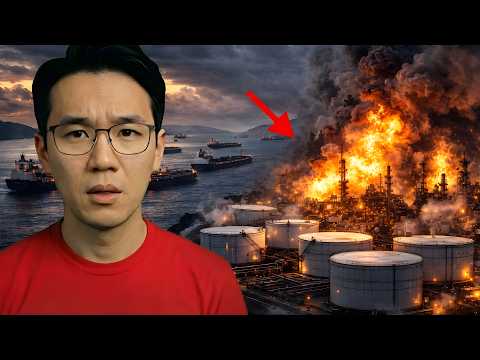
I noticed this on TLN (H/T K) :
I haven’t got round to watching the youtube above - my system seems to hate youtube for some reason so I don’t know whether Craig Tindale’s in depth analysis of all the potential cascading dominoes flowing from the closure of Hormuz has already been exposed.
"Executive Summary
The modern world order, having organized itself around efficiency, cost minimization, and logistical precision, has created a machinery of dependence so extreme that the interruption of one narrow corridor can propagate outward into a general crisis of civilization.
What appears at first as a maritime blockade is in fact the exposure of the entire global system as a hierarchy of brittle interdependencies.
Oil and LNG fail as inputs into electricity, fertilizer, shipping, chemicals, mining, manufacturing, and state finance.
As an example, The global polyester chain begins in petrochemicals. A severe disruption to hydrocarbon and petrochemical feedstocks cascades into PTA, MEG, polyester resin, filament, and fabric production, causing acute shortages, price spikes, and factory stoppages across synthetic-heavy apparel segments. The industry does not vanish overnight, but the low-cost, high-volume apparel model starts to break down.
From this follows a chain whose logic is cumulative: fuel inflation becomes fertilizer inflation; fertilizer inflation becomes food inflation; food inflation becomes urban instability, sovereign subsidy exhaustion, and ultimately hunger. In this sequence, food shortages are not a secondary humanitarian issue. They are one of the central political outcomes of the crisis, because modern populations do not experience systemic breakdown first through grand strategy, but through unaffordable bread, intermittent power, empty pharmacies, and possibly the collapse of public order. A globalised Arab Spring.
In this framework, hyperinflation emerges as the social expression of real physical bottlenecks. When energy-importing states are forced to acquire dollarized fuel at any price, when currencies weaken, when fertilizer and transport costs reprice an entire harvest cycle, inflation ceases to be cyclical and becomes coercive.
It enters every household budget and every state ledger at once. The result is the destruction of planning itself: firms cannot quote, governments cannot subsidize, and populations can no longer calculate the future. Under such conditions, credit markets seize up, foreign-exchange reserves drain, sovereign spreads widen, and the boundary between economic crisis and political crisis disappears.
Modern technical systems amplify rather than dampen this disorder. The loss of sour crude becomes a sulphur and sulphuric acid crisis; that chemical crisis becomes a copper and cobalt crisis; the metals crisis becomes a transformer, switchgear, and grid crisis; the grid crisis becomes a semiconductor crisis; and the semiconductor crisis becomes a compute and data-centre crisis.
Thus, the closure of a maritime strait reaches, by entirely material means, into the server rack, the hospital network, the payment system, the electrical substation, and the defence-industrial base. The myth that digital civilization floats above heavy industry is, in this scenario, extinguished. Compute is shown to rest on copper, transformers, stable voltage, LNG, and ships.
For humanity, the systemic risk is total in scope, even if unevenly distributed.
The most immediate suffering falls on import-dependent and fiscally weak societies: blackouts, food insecurity, unemployment, debt default, regime stress, and mass unrest. Yet the advanced economies do not escape. They experience industrial contraction, infrastructure delays, AI and semiconductor bottlenecks, strategic stockpiling, and the permanent repricing of security over efficiency. What begins as a supply shock ends as a transformation of the political economy. States abandon the fiction of neutral markets and move toward command allocation, export controls, emergency powers, and militarized trade corridors. Market price gives way to strategic rationing. Globalization does not simply slow; it hardens into armed blocs.
The ultimate conclusion is grim : the terminal danger in this model is not one shortage, nor one recession, nor even one war-risk premium.
It is the transition from a globally integrated commercial order into a world system governed by scarcity, coercion, and administrative triage.
In such a world, hunger, hyperinflation, sovereign failure, technological stagnation, and geopolitical militarization are not separate crises.
They are the normal operating features of a civilization that has discovered, too late, that its efficiency was built on concentrated fragility. The closure of Hormuz, under this analysis, is the event through which the modern world recognizes that its supply chains were never only economic structures, but the hidden constitution of social peace itself.
A multipolar world is a very complicated and dangerous world. As always, be careful what you wish for.
Such is the risk. The whole world will be compelled to support efforts to bring this situation under control immediately. China, the US, and Europe will have to work together.
The political cycle over the coming days and weeks is going to matter like never before. "
cheers
PS I’ve just watched the youtube posted by @Rich - it’s very good and easily understandable and although alarming it still misses a lot of the cascading dominoes mentioned by Craig T - all the sulpher, copper, phosphates and fertilizers as well as the devastating impact on technology like AI.
Commentators also mention the impact on aviation - airline bankruptcies are quite likely, cutting international travel and destroying tourism in the World.
It’s well past time for our parliamentary loonies to get a grip - no-one expects the executive to do anything apart from repress free speech and free demonstrations and of course people.
PPS I note that the only comment on TLN is in the format of a BiBiC smear by question : “was this AI generated” - even though in the same post he notes commentator on the CT website refer to CT engaged in podcasts on the subject!
Lots of videos of CT - look up “Craig Tindale podcast” - why mention AI at all unless cognitive dissonance is kicking in!