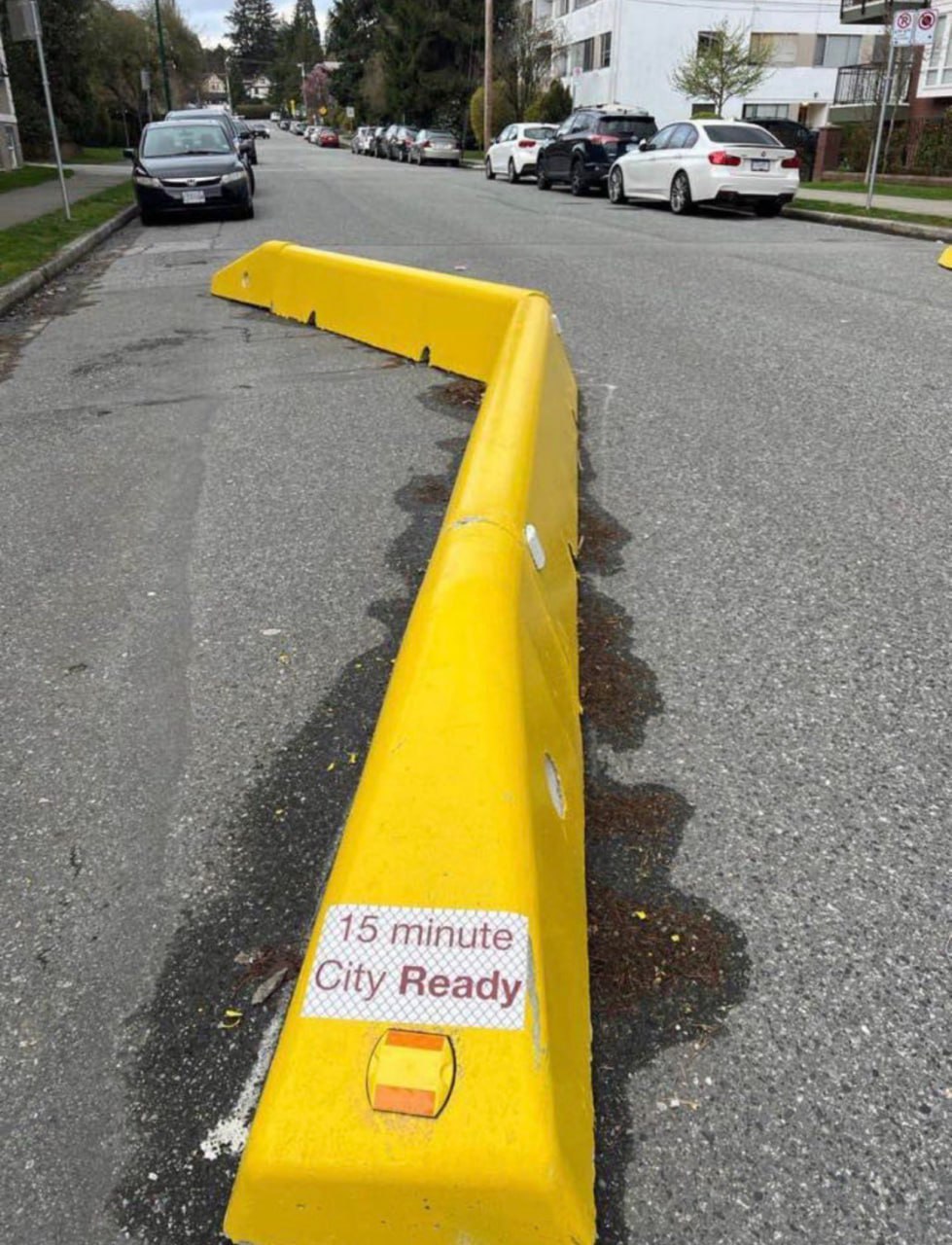
Pay wall Telegraph article
https://www.telegraph.co.uk/gift/e4fa664b08f27cd7
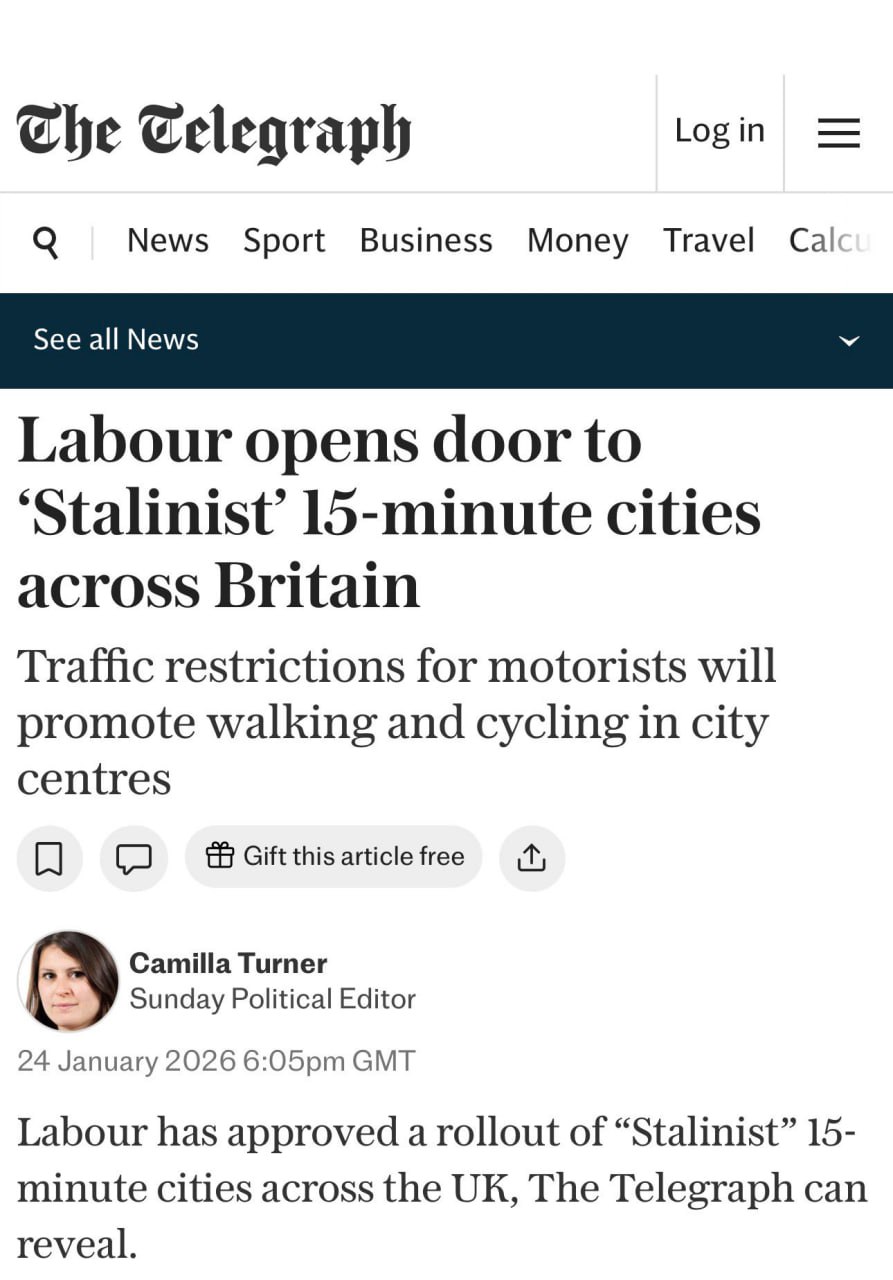
Labour opens door to ‘Stalinist’ 15-minute cities across Britain
Traffic restrictions for motorists will promote walking and cycling in city centres
Camilla Turner Sunday Political Editor
24 January 2026 6:05pm GMT
Labour has approved a rollout of “Stalinist” 15-minute cities across the UK, The Telegraph can reveal.
Ministers have said that they will allow councils to use driver licence databases to impose fines on drivers who fall foul of “traffic filters”, which restrict driving in certain areas.
The controls on motorists, which are to be implemented for the first time in Oxford city centre later this year, have been described as “perverse” by motor groups.
The 15-minute city is based on the idea that a person can access amenities within a quarter of an hour by walking or cycling. In some cases, this could result in traffic restrictions being brought in for drivers.
Greg Smith, shadow transport minister, said: ‘Oxford is the test case, but this is Labour’s blueprint for the country’ Credit: House of Commons
The most high-profile example of such a plan is in Oxford, where the council put forward proposals to divide the city into six “15-minute neighbourhoods”.
Under the scheme, drivers would need a residents’ permit that allows 100 days of free travel per year through six traffic filters during operating hours.
Meanwhile, a separate permit allows 25 days of free travel per year through six congestion charge locations during charging hours, and after this, drivers face fines if they travel without the relevant permission.
Greg Smith, shadow transport minister, said: “This is the blueprint for a national rollout. Labour has given the green light for draconian councils like Oxfordshire to police how people live, move and drive, using cameras and fines backed by DVLA data.
“Oxford is the test case, but this is Labour’s blueprint for the country.”
‘A page out of the East Germany playbook’
Duncan White, director, of the Alliance of British Drivers said 15-minute cities were an “abomination”.
He said it was a “perverse” and “Stalinist” approach to social control, adding: “It is an encroachment on civil liberties, and it is a page out of the East Germany playbook.
“With the 15-minute city, you will have to, in effect, apply for an internal passport to go and visit your granny. From a civil liberties perspective, it is nonsensical. From an operational point of view, it is bizarre.”
Jack Cousens, head of roads policy at the AA, said: “What local authorities sometimes struggle to remember is that the car remains and continues to remain the main method which people use to travel around our country.
“Cars coming into the town centres generate a huge amount of parking revenue for local authorities, and the local high street is dependent on strong, consistent footfall, and cars are probably the easiest way for people to get in and out of town centres.
“We don’t want barriers that harm the national economy and the local economy.”
Under the previous government, plans were drawn up to block councils from using the driver licence database to implement traffic restriction measures.
In 2023, the Tories announced that they would consult on legislative changes and new guidance, including removing councils’ access to DVLA data where schemes relied on excessive camera enforcement, rationed car use, or failed to command the backing of residents and local businesses.
Simon Lightwood, the local transport minister, responded to a parliamentary question by Richard Holden, the shadow transport secretary, by confirming Labour would proceed with this approach.
This means councils across the country could follow Oxford’s lead and introduce camera-enforced traffic filters.
It comes after The Telegraph revealed last month that Labour has started a crackdown on parking spaces.
‘Dangerous driving’
Under plans published by the Government, councils will be required to impose sweeping parking restrictions limiting the number of spaces on new housing developments without any justification.
Labour has also dropped plans to curb the rollout of controversial Low Traffic Neighbourhoods and 20mph zones.
Ministers ditched reforms that would have restricted council powers to control traffic and levy “unfair” fines and parking charges.
A Department for Transport spokesman said: “Local councils use DVLA data to help keep our roads safe and crack down on dangerous driving. How they use this information is up to each council, so it works best for their communities.”
The spokesman added that implementing traffic filters and other traffic management measures is a local authority matter, and the government has “no plans” to get involved in the roll-out of these schemes.
Join the conversation
The Telegraph values your comments but kindly requests all posts are on topic, constructive and respectful. Please review our commenting policy.
More from News
I’ve never known what to make of this proposal, which has only been floated in vague terms.
If it’s about restricting car use, a case could be made which depended on man-made climate change theory, which a substantial number of people reject or are unconvinced by.
But if that were the explantion, it would involve pushing longer journeys onto public transport. Yet in the blurby descriptions there is no mention that movement by public transport outwith the 15 minute regions will still be unrestricted. Rather the explanations tend to be suspiciously rhetorical - stressing things like quality of life, better serving communities, improving social infrastructures, improving equality for disadvantaged groups.
This Wikipedia article presents the idea in positive, almost honeyed terms, while assuring us, (like Napoleon in Animal Farm), that we should got get any stupid conspiratorial ideas about the purpose being to restrict us.
Also massive investment in public transport would be needed to cope with extra demand, and it’s inconceivable that expanded public transport wouldn’t be included in discussions - given the UK can (we are told) hardly afford the levels of public services it already has. And descriptions invariably mention walking and cycling within the 15-minute limit, not taking the bus or train outside it.
So I think I already have my answer to the public transport question. The fact that we have to ask this question is its own answer. Probably public transport would just be reduced.
There is the small matter of human rights. For example, off the cuff, the right of freedom of association.
And here’s Article 13.of the Universal Declaration of Human Rights:
" Everyone has the right to freedom of movement and residence within the borders of each state."
" Everyone has the right to leave any country, including his own, and to return to his country."
Link: https://www.un.org/en/about-us/universal-declaration-of-human-rights
It’s not easy to see how this idea or scheme can get off the ground without being buried in opprobrium, once it becomes necessary to furnish details.
With this in mind, the lack of proposed detail - furtiveness - together with the reluctance to instigate public discussions, as well as the suspiciously one-sided and soft descriptions - of what would be a massive project - come across as ominous.
But I await more informed commentary.
DIGITAL ID - THE FINAL LOCKDOWN. We must get rid of these devices at any cost!!!
Still on Bitchute after 3 years in case anyone hasn’t seen it. (Video is a bit slow loading I noticed).
The endgame:
I’ve seen a number of this type of podcasts, but all left some doubt in my mind. This one swept away the doubt, and reminded me of something that seemed fishy to me at the time.
I was at a small seaside resort town, mid summer. The streets where all the bars, restaurants and cafes were had street lamps. They were clearly all LED. They were on higher poles than I had seen before and each pole had lights pointing in every direction, not down. They were not as far apart as one might expect for street lighting. That looked a little sus to me having heard of these type of lights before. The video you posted, nails exactly the situation these would be used in, and in a highly believable way.
Since we’re all climate deniers here (just love that term!) why not make much stronger cases based on the ubiquitous misappropriation of land and exploitation of people for the sake of the private motor car; the deaths and maimings and psychic damage ‘we’ tolerate caused by people i/c these lethal weapons with little (and less as time goes by) regard for their victims (the selfishness of ‘the driver’ is something extraordinary), the massive pollution caused during production, (mis)use and final disposal of these bloody things . . . , the power obtained by all the associated corporate entities and individuals over political decision making (let’s think, where did Trevor Chinn get the money to bankroll Starmer?), all predicated on the global rollout of ‘private motoring’
Endless lists. fed up already. Anyone read Heathcote Williams’ Autogeddon? And that was decades ago. Now we have cars controlled digitally in which most people appear to be happy with the prospect of drowning in an electronic soup while picking the kids up from school. How the fuck did we manage 100 years ago?
M & I gave up ‘running a car’ 25 years ago. Since then we’ve lived and worked ‘successfully’, perfectly happily, in Bradford, Bristol, Shrewsbury and, for nearly 10 years now, a small village in the High Peak. Getting about as well as we can!!
‘Ominous’? Bloody sinister more like. Of course this project is all about social control of people. In the end the digital checkpoints will be/are being designed for people. Just forget the cars, they’re red herrings.
I agree with your tirade against cars but I was making a different point.
“Since we’re all climate deniers here (just love that term!) why not make much stronger cases based on the ubiquitous misappropriation of land and exploitation of people for the sake of the private motor car…”
Because man made climate change is supposed to be one of the main reasons behind smart cities. I wanted to show up this supposed reason as being seemingly bogus.
(I’ve never been a ‘climate denier’ btw  )
)
Do you suggest the small extremely rapid BMW saloon or the big Merc with a V8? Kinda stuck on which to choose for my next project.
Come on LY, spoil yourself; a Trabant or at least a Lada.
Hi folks Iain Davis’ take on FMCs here:
Cheers
Great article CJ! Thanks for posting.
I’d love either of these. But they’re like chicken lips nowadays.
I’ll be thinking about a Lada Cosworth for days now.